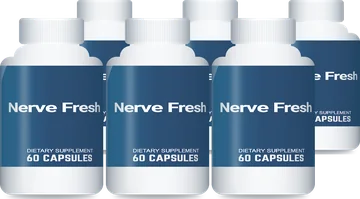
Nerve Fresh Capsules marshmallow root is the second ingredient on the panel, printed as "Marshmallow Root Powder (Althaea officinalis)" at 220 mg per serving of two capsules 1. It is about 23 percent of the five listed amounts.
Mount Sinai describes marshmallow's mucilage as coating the stomach lining, and that is behind the main practical point on this page: it may slow how your body takes up other medicines. Below we cover the label line, the traditional uses recognised in Europe, the absorption, blood sugar and lithium cautions, and the questions to bring to a pharmacist. Checked on Nov 26, 2026.
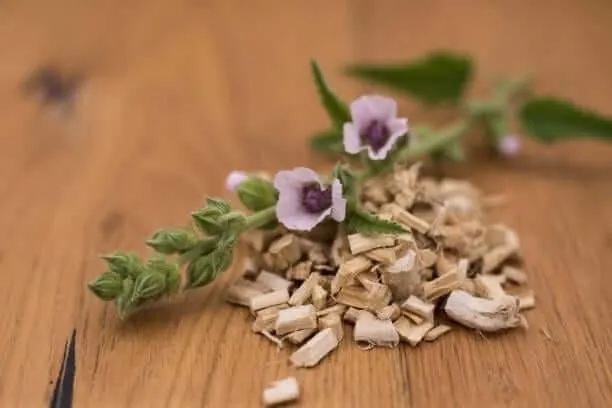
How much marshmallow root is in Nerve Fresh Capsules?
A serving of two capsules contains 220 mg of marshmallow root powder, or 110 mg per capsule. It is the second-largest amount on the label, after passion flower at 350 mg.
The five listed amounts add up to 960 mg per serving, and marshmallow root makes up about 23 percent of that. It is one of three powders in the formula; corydalis and California poppy are listed as extracts.
Because each active has its own printed amount, a pharmacist can see the exact Nerve Fresh Capsules marshmallow root figure rather than guessing from a blend total. The whole panel is explained on our Supplement Facts page, and the full ingredient list summarises the other four plants.
What the label prints about marshmallow root
The Nerve Fresh Capsules Althaea officinalis line gives the common name, the Latin name, the plant part (root), the form (powder) and the amount. That is more detail than it gives for passion flower, which has no species named.
What the label does not give is any standardisation, source country or preparation method. It also does not say why marshmallow root is in the formula. The bottle makes no structure or function claim for any ingredient, only the standard FDA statement.
If you need to know more about how the powder is made, the order desk at +1 (302) 200-3480 is the place to ask. We do not fill gaps with guesses.
One more label detail is worth knowing: the facility statement on the left panel says the product is made in a facility that may also process milk, soy, wheat, egg, peanuts, tree nuts, fish and crustacean shellfish 1. That applies to the whole capsule, not only this ingredient, and our allergen page covers it.
What is marshmallow root traditionally used for?
The European Medicines Agency's herbal committee recognises marshmallow root under traditional use for mouth or throat irritation with a dry cough, and for mild stomach discomfort 2. Traditional use means long-standing use, not proof from clinical trials.
The EMA also advises seeing a doctor if symptoms last more than one to two weeks. That advice applies to marshmallow root products sold in Europe for those purposes.
None of these traditional uses relate to the reasons the seller markets this product. The seller's ads use nerve-related language; this site makes no such claim, and no source we cite links marshmallow root to nerve symptoms. Our label claims page separates what the bottle says from what the ads say.
Why mucilage matters for your other medicines
Mount Sinai says marshmallow's mucilage coats the stomach lining and may slow the absorption of other drugs or herbs taken at the same time 3. That is the most practical caution for this ingredient.
Slower absorption could matter for medicines where timing and steady levels count. Mount Sinai suggests taking marshmallow several hours apart from other medicines and asking a pharmacist, rather than taking everything together.
The Nerve Fresh label says nothing about spacing. It says only to take two capsules daily and not to exceed the recommended dose. So the spacing question is one to settle with your pharmacist before you start, especially if you take several daily medicines.
Mount Sinai's note covers herbs as well as drugs, so other supplements you take count too. If you use a fiber product, a multivitamin or another herbal formula, put it on the list you show your pharmacist. A single written schedule for everything you take, kept in your wallet or on your phone, is easier to follow than separate notes for each item.
How to plan spacing with a pharmacist
A pharmacist can tell you how far apart to take these capsules from each of your medicines. These steps make that conversation quick and specific.
- List every prescription, over-the-counter medicine and supplement you take, with the times you take them.
- Show the pharmacist the label, pointing out the 220 mg of marshmallow root.
- Ask which of your medicines are most sensitive to slower absorption.
- Agree on a daily schedule that keeps the capsules apart from those medicines.
- Write the schedule down and keep it with your medicine list.
The sales copy adds "with food"; the label does not mention food; ask your pharmacist 4. Meals may also affect your spacing plan. Our page on taking it with food covers that conflict, and the how-to-use page sets out the label directions.
Marshmallow root and diabetes medicines
Mount Sinai says one study suggests marshmallow may lower blood sugar, so people with diabetes should talk to their doctor 3. This is a caution, not a benefit.
For anyone taking insulin or other diabetes medicines, the concern is blood sugar dropping too low. Prickly pear, another ingredient in this formula, carries a similar caution in its sources, so the two together are worth raising with your prescriber.
Ask your prescriber before starting if you take diabetes medicines; low blood sugar is the concern. Do not change your diabetes medicines on your own. Our diabetes page brings the source notes for both ingredients together, and the prickly pear page covers that plant on its own.
Marshmallow root and lithium
Mount Sinai lists a lithium caution for marshmallow 3. If you take lithium, talk to your prescriber before you take any product that contains marshmallow root.
Any question about lithium belongs with the doctor who prescribes it. The label does not mention lithium, and neither does the seller's copy, which is why reading ingredient sources matters.
The same goes for any medicine you take on a strict schedule. Our medications page sets out what sources say for each medicine type across all five ingredients.
Where marshmallow root fits in the formula
Marshmallow root is the only one of the five ingredients whose sources focus mainly on how it affects other medicines rather than on drowsiness. That makes it a different kind of question from the other four.
Three ingredients, passion flower, corydalis and California poppy, carry drowsiness notes in their sources. Prickly pear carries a blood sugar caution and stomach side effects. Marshmallow root adds the absorption point, plus its own blood sugar and lithium cautions.
So when you review this product with a pharmacist, marshmallow root is the ingredient that turns the conversation toward timing. The question is not only whether to take it, but when, relative to everything else on your list. The label gives no answer to that, which is why we route it to a professional. Our passionflower page and corydalis page cover the other side of the formula.
Marshmallow root side effects: what sources list
The sources we cite on marshmallow root focus on interactions rather than a list of side effects. Their main notes are slower absorption of other medicines, a possible effect on blood sugar, and a lithium caution.
That does not mean side effects never happen; it means our sources do not describe a specific list, and we do not invent one. If you notice anything unusual after starting, stop and call your doctor.
NCCIH points out that "natural" does not mean safe, and that products can interact with medicines 5. NIH's Office of Dietary Supplements advises telling your providers about any supplement you take and reporting problems 6. Our side effects page covers what sources describe for all five ingredients.
Nerve Fresh Capsules marshmallow root: sources in one table
This table brings the points together, with the person best placed to answer each one. It describes marshmallow root in general, not this product.
| Question | What sources say | Who to ask |
|---|---|---|
| Traditional uses | Mouth or throat irritation with dry cough; mild stomach discomfort (EMA) | Your doctor, if symptoms last over 1 to 2 weeks |
| Other medicines | Mucilage may slow their absorption; take hours apart (Mount Sinai) | Pharmacist |
| Diabetes medicines | One study suggests blood sugar may drop (Mount Sinai) | Prescriber |
| Lithium | Caution listed (Mount Sinai) | Prescriber |
| Form on the label | Root powder, Althaea officinalis, 220 mg per serving | Order desk for preparation details |
Frequently asked questions
How much marshmallow root is in each Nerve Fresh Capsules capsule?
110 mg. The label prints 220 mg of marshmallow root powder per serving of two capsules, so each capsule holds half.
Can the marshmallow root in Nerve Fresh Capsules affect my other medicines?
It may. Mount Sinai says marshmallow's mucilage may slow the absorption of other drugs and suggests taking it hours apart. Ask your pharmacist how to space it from your medicines.
Should I take Nerve Fresh Capsules at the same time as my morning pills?
Ask your pharmacist first. Because of the marshmallow root absorption note, taking everything together may not be ideal. The label gives no timing advice.
Is the marshmallow root in Nerve Fresh Capsules a concern with lithium?
Mount Sinai lists a lithium caution for marshmallow. If you take lithium, talk to your prescriber before using this product.
Is the marshmallow root in Nerve Fresh Capsules a concern if I take diabetes medicines?
It is worth asking about. Mount Sinai says one study suggests marshmallow may lower blood sugar, and prickly pear in the same formula carries a similar note. Ask your prescriber before starting; low blood sugar is the concern.
Which marshmallow species is listed for Nerve Fresh Capsules?
Althaea officinalis. The label prints the Latin name next to "Marshmallow Root Powder", unlike the passion flower line, which names no species.
Sources for this page
- Nerve Fresh bottle label (full label wrap photo in the owner pack: Supplement Facts, suggested use, caution, storage, distributor)
- European Medicines Agency: Althaeae radix (marshmallow root) herbal medicinal product
- Mount Sinai Health Library: Marshmallow
- Nerve Fresh owner pack (contacts, returns, refund steps, lot and CoA references, product and price notes)
- NCCIH: Safe Use of Complementary Health Products and Practices
- NIH Office of Dietary Supplements: Dietary Supplements: What You Need to Know
Label words come from the full Nerve Fresh Capsules label-wrap photo. Contacts, returns, refund steps and the price note come from the owner pack, checked Nov 26, 2026. The guarantee length is stated on the seller’s sales page; the owner pack says to confirm the live policy. Where sources differ, the printed label wins.